Guest Post: Coffee Houses-the Georgian Equivalent of Facebook? by Grace Elliot

As part of her Verity’s Lie blog hop, I am delighted to announce my very first guest poster! Author Grace Elliot is joining us today, with a fascinating post about coffee houses in the Georgian era. Grace is the successful author of historical romance novels, including her new book Verity’s Lie, and a regular contributor to the English Historical Fiction Authors blog in addition to maintaining her own blog. Be sure to check out the links below after enjoying her post. Take it away, Grace!

Coffee Houses – the Georgian Equivalent of Facebook?
by Grace Elliot
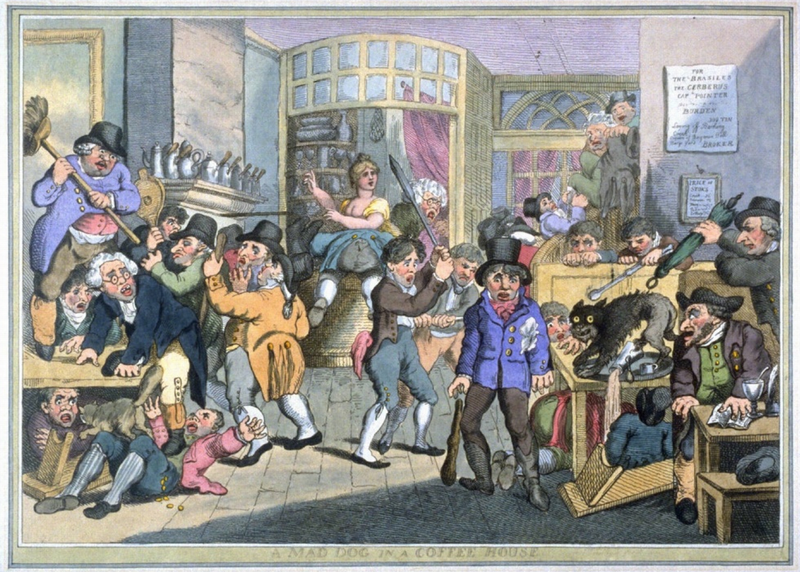
A Mad Dog in a Coffee House, by Thomas Rowlandson

In the 18th century coffee houses were big business – much like today! A bit like the roll social media plays in the modern age, coffee houses were places for like-minded people to meet and debate issues or conduct business. In the previous century King Charles II recognised and was intimidated by the potential within coffee houses to organise rebellion and tried to ban them as:
“places where the disaffected met, and spread scandalous reports concerning the conduct of His Majesty [Charles II] and his Ministers”

Their history is such that it took just over two decades from coffee being available outside the Ottoman Empire, for a rash of them to appear all over Europe. England’s first coffee house opened in Oxford in 1652, and by 1675 there were over 3,000 countrywide! Indeed, coffee houses were the fore-runner of the private gentlemen’s clubs that became so popular in the late 18th century.

The popularity of coffee houses lay not so much in the hot beverages they sold, but as a meeting place. Each house had a distinctive clientele who gathered there to hear the latest news or gossip. By 1739, in London alone there were 331 coffee houses catering for various political groups, lawyers, doctors, stockjobbers, writers, artists or the like. A Frenchman, Antoine Prevost, visiting London commented that coffee houses were “the seat of English liberty”, a place “where you have the right to read all the papers for and against the government.” They also served another social function as a place to have mail delivered, to collect lost property or read newspapers.

One of the most famous coffee houses was Garraway’s, near the Royal Exchange in London. In the 1800’s you could purchase four ham sandwiches and a glass for sherry for two old pence, or feast on a pot of tea, six slices of bread, two crumpets and a muffin for a cost of ten pence plus a two pence tip for the waiter. But, men went there to do business, rather than dine. At Garraway’s people of quality met to buy and sell books, paintings and shipments of tea, coffee or wine. This was done by the famous “inch of candle” sales – a bizarre system of auctioning goods where the successful buyer was the last person to place a bid before a candle stub burnt out.

Coffee houses were great social levelers when men of different classes could meet. It was not unusual for a physician to meet his patient there, or a lawyer his client. Added to that the coffee houses were often gloomy, poorly lit places with smoky atmospheres – they were the perfect places to meet people without arousing suspicion.

In my latest historical romance, Verity’s Lie, the hero wishes to intruct a spy, so what better meeting place than a coffee house!

Excerpt from ‘Verity’s Lie’.

Needham’s Coffee House was a place of business rather than pleasure, and the rooms were decorated accordingly. In the hearth hung a cauldron of coffee from which the servers filled their jugs. Clean sand on the floor, and a candle lit each wooden table; the patrons preferring their transactions to be conducted in the anonymity of gloom.

Ryevale entered this thick atmosphere of tobacco, coffee and coal smoke, the sickly smell catching at the back of his throat. Like so many shadowy monoliths, an assortment of merchants, lawyers, physicians and stock-jobbers sat hunched around tablets, deep in conversation.

Giving his vision time to adjust, Ryevale ducked to avoid a beam and crossed to his favorite corner booth with a view of the door. Sitting, he placed a document on the table and ran a finger down a column of figures, as if there to meet to his broker.
“Coffee, my lord?”
“Thank you, Williams. Most kind.”
“Very good, I’ll see to it myself.”

Williams was Needham’s proprietor; a man both unobtrusive and tight lipped, his character reflected in the coffee house’s reputation for discretion. A well-dressed man wearing a pristine white neckcloth slid into the seat opposite, a copy of the Spectator clamped under his arm. His skin glowed with the freshly scrubbed appearance of a man come directly from the barber, a man who took pride in his appearance. Ryevale looked up and nodded.
“Hanley.”
“Coffee for me as well, Williams.”
“Of course, Mr. Hanley.” Williams melted backwards.
“Good of you to come at short notice. I appreciate it, Hanley.”
“No trouble.”

A serving wench brushed past the table, casting doe-eyes at Ryevale, who smiled back absent-mindedly.

“Anything in the news?” he asked, nodding to the Spectator.
“The usual from abroad: Napoleon’s antics on the run…another ambush…that sort of thing.” Hanley had a cultured voice with an aristocratic twang.
“How is business?”
“Stocks are booming, despite the unsettled situation.”
“Any tips?”
Hanley grinned. “After inside information?”

Williams approached with a coffee jug and two cups. “Here we are, your lordship, Mr. Hanley.”
“Thank you, Williams.” Ryevale pressed a shilling into his hand.
“My lord.” Williams discretely withdrew.

Once alone with no one to overhear, Hanley leaned across the table with a glint in his eye.
“Enough small talk. I take it you need information?”
“I do.”
Hanley smiled as he poured the coffee. “Good. Town has been dull lately; a diversion would be welcome.”
Author biography and links:Grace Elliot
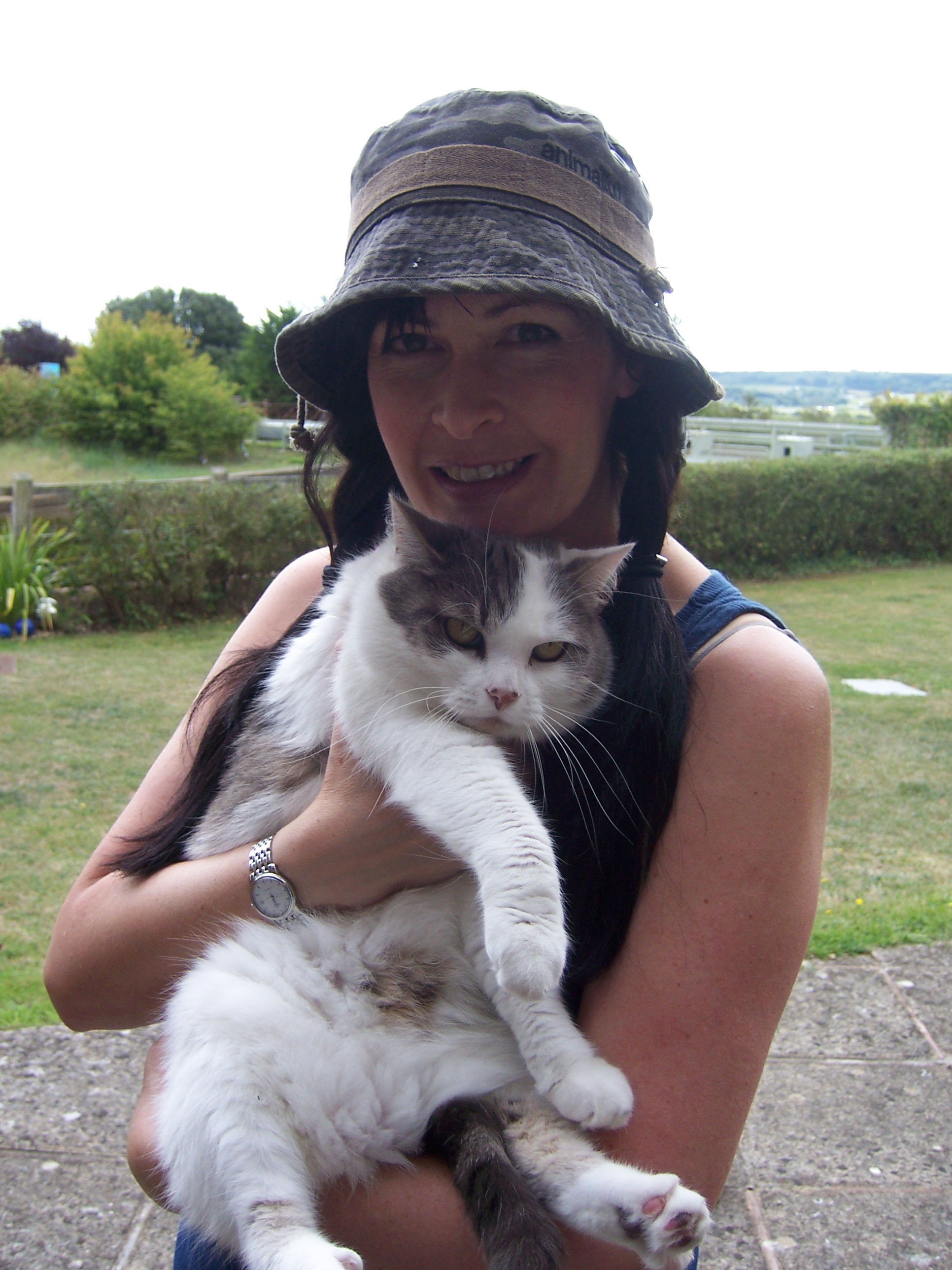
Grace Elliot
Grace Elliot

Grace Elliot leads a double life as a veterinarian by day and author of historical romance by night. Grace lives near London and is passionate about history, romance and cats! She is housekeeping staff to five cats, two sons, one husband and a bearded dragon (not necessarily listed in order of importance). “Verity’s Lie” is Grace’s fourth novel.
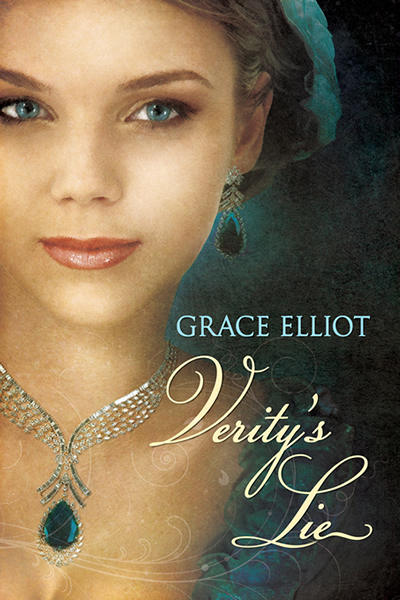
Verity's Lie-400x600 Cover

Verity’s Lie – Synopsis:

Charles Huntley, Lord Ryevale, infamous rogue…and government agent.
In unsettled times, with England at war with France, Ryevale is assigned to covertly protect a politician’s daughter, Miss Verity Verrinder. To keep Verity under his watchful eye, Ryevale plots a campaign of seduction that no woman can resist– except it seems, Miss Verrinder. In order to gain her trust Ryevale enters Verity’s world of charity meetings and bookshops…where the unexpected happens and he falls in love with his charge.
When Lord Ryevale turns his bone-melting charms on her, Verity questions his lordship’s motivation. But with her controlling father abroad, Verity wishes to explore London and reluctantly accepts Ryevale’s companionship. As the compelling attraction between them strengthens, Verity is shattered to learn her instincts are correct after all – and Ryevale is not what he seems. So if Lord Ryevale can lie, so can she… with disastrous consequences.

BUY LINKS
Amazon .com http://amzn.to/13CxrN1
Amazon.uk http://amzn.to/12aEqI6

Links:
Subscribe to Grace’s quarterly newsletter here: http://bit.ly/V7T6Jd
Grace’s blog ‘Fall in Love With History’ http://graceelliot-author.blogspot.com
Website: http://graceelliot.wix.com/grace-elliot
Grace on Twitter: @Grace_Elliot
Grace’s author page on Amazon: http://www.amazon.com/Grace-Elliot/e/B004DP2NSU/ref=ntt_athr_dp_pel_1
Facebook: http://www.facebook.com/pages/Grace-Elliot/173092742739684?v=wall&sk=wall

Watch this space…

Voltaire Welcoming His Guests, by Jean Huber

Tomorrow, my very first guest blogger will be posting. Grace Elliot is a talented historical fiction author with four books to her credit, a contributor to the English Historical Fiction Authors’ blog, and has her own blog Fall in Love with History (http://graceelliot-author.blogspot.com). In her other life, she is a veterinarian! I know you will enjoy her post, so please be here tomorrow! Don’t forget to share!

(Illustration: Wikimedia Commons http://upload.wikimedia.org/wikipedia/commons/thumb/3/37/Jean_Huber_-_Voltaire_Welcoming_his_Guests_-_WGA11785.jpg/388px-Jean_Huber_-_Voltaire_Welcoming_his_Guests_-_WGA11785.jpg )

What Matters In Jane Austen?

Any fan of Jane Austen’s novels has become accustomed to seeing new books about her, her novels and her writing skills almost on a daily basis. I recently purchased and read WHAT MATTERS IN JANE AUSTEN? Twenty Crucial Problems Solved by John Mullan (Bloomsbury Press, 2013). I found this to be an enjoyable read, and a useful work. Mr. Mullan has presented a collection of essays dealing with certain concepts that appear in Jane Austen’s novel, and explaining their significance. Questions of age, the importance of the weather, who speaks or (just as importantly) who never speaks, illness, blushing and other topics all are examined. In each of these chapters, Mr. Mullan’s insights gave me additional perspective on each novel. These new perspectives have made me more aware of points of view, mores of the time, Austen’s subtlety, and other things that have deepened my appreciation and enjoyment of Austen’s writing.

For example, in the chapter about weather, Mr. Mullan indicates that Jane Austen is the first novelist to point out weather shifts that might occur during any normal day, and to use them to highlight and to move her plots. While I cannot address his contention that Austen is the first to use weather in this way, I can say that, after reading this chapter, I have a much keener awareness of and appreciation for the significance of the weather throughout her novels. It isn’t that the reader is unaware of the impact of the weather on the various stories; Mr. Mullan’s discussion has a way of highlighting the significance of the weather and its changes in context. Many modern readers live in a climate-controlled situation. Going to visit a friend on a rainy day means going from one’s door to one’s car, barely dampened by the rain. The real effect of walking three miles on a rainy day in a muddy lane doesn’t have the immediacy for us that it would have had for Jane Austen’s contemporaries. After reading Mr. Mullan’s essay, I am much more aware of the significance of the mentions of the weather in the novels, and have found that this increased awareness has brought even more life to the stories. Sometimes he addressed things that I felt, but had not consciously thought about in reading the novels. The other chapters have had a similar effect for me. It was interesting to find that some topics that seemed obvious had depths I had not previously considered sufficiently.

Mr. Mullan’s writing style is very easy to read, with a conversational tone. It is rather like reading letters from a friend who explains why he liked something or found an idea important. He is obviously well versed, citing Austen’s letters and the novels in support of his ideas very convincingly. The chapters are titled, and each reads well. He provides notes and a bibliography, so the reader can study further. I enjoyed reading it, and especially enjoy the fact that my appreciation for Austen’s writing has only increased.

Here is a link to this book on Amazon: http://www.amazon.com/What-Matters-Jane-Austen-Crucial/dp/1620400413/ref=sr_1_1?s=books&ie=UTF8&qid=1369686970&sr=1-1&keywords=what+matters+in+jane+austen

Happy Anniversary, English Historical Fiction Authors!

     This week, the English Historical Fiction Authors’ blog is celebrating its one year anniversary!   Author Debra Brown, who spearheaded this blog, has written a great article providing some highlights, the top ten posts and other items of interest.   (One of my posts is number 3!)  Be sure to take a look at the various posts-there is truly something for everyone, from food to fashion to politics and war.  There is also a great giveaway of books by associated authors to celebrate this milestone.  Please go HERE http://englishhistoryauthors.blogspot.com/   and check it out!  You’ll be glad you did!

Jane Austen and Modern America

     As a reader and admirer of Jane Austen’s works, I have been told on occasion that her works, as delightful as they may be, are not really relevant to today’s world, and are escapist or elitist, or basically “chick lit”.  As pleasurable as I have found them, it must be said that the movie adaptations do little to counter this judgement.  I was browsing through my library’s on-line catalogue, and ran across two books whose titles caught my attention:

A JANE AUSTEN EDUCATION How Six Novels Taught Me About Love, Friendship, and the Things That Really Matter by William Deresiewicz, and

A WALK WITH JANE AUSTEN A Journey into Adventure, Love & Faith by Lori Smith

     Both authors wrote memoirs that discuss their personal lives in relation to insights from Jane Austen’s life and novels.  That said, it would be hard to find two more different people and life experiences.  It is intriguing to note just how much each author was inspired by Jane Austen, and how they applied the insights they gained to their personal lives.

     Mr. Deresiewicz studied Austen’s novels, and by extension, her life as part of a graduate program, ultimately including his findings in his dissertations.  Facing emotional and physical problems, Ms. Smith took a walking tour in England, following Jane Austen’s life, seeking answers to questions of faith and personal fulfillment.  Both found more than they bargained for.    Both authors learned life lessons, internalized values and ideas, and acquired a knowledge of themselves that they had not had not previously had.

     These books are, of necessity, very different.  The authors are two completely different human beings, of completely different backgrounds.  They approach Austen from different places in their lives, for completely different reasons.  Mr. Deresiewicz was totally uninterested in reading Jane Austen, and Ms. Smith was an ardent fan.  Both travel with Austen (Mr. Deresiewicz on an intellectual  journey of maturation, and Ms. Smith on a literal journey of faith) and come away with unexpected knowledge of themselves.

     After reading them and thinking about them, I went back and read some reviews of each.  Interestingly, some reviewers commented on both authors’ self-indulgence and whining.  Since these are memoirs of the authors’ experiences and emotions, I think one must expect to share some of their angst and less positive issues; it is unrealistic to expect all sweetness, light, and moments of ecstatic recognition.  There were aspects of both authors that made me want to smack each, for completely different reasons.  However, I found both books to be enjoyable and thought-provoking.  Reading their experiences and viewpoints of one of my favorite authors has helped me to understand and clarify much of what I find appealing and relevant to my own life.  The universal truths that Jane Austen addresses so subtly in her novels, and the way she lived her life, still have much to do with our lives today.  Mr. Deresiewicz and Ms. Smith have demonstrated that in their respective memoirs.  I recommend them both.

Deresiewicz, William.  A JANE AUSTEN EDUCATION How Six Novels Taught Me About Love, Friendship and the Things that Really Matter.  2011: Penguin Press, New York, NY.

Smith, Lori.  A WALK WITH JANE AUSTEN A Journey into Adventure, Love & Faith.  2007: WaterBrook Press, Colorado Springs, CO.

The Work In Progress Is Progressing…

I have finally fought my way out of one chapter into another! Periodically, I hit a section where it seems to go on forever. However, it is moving forward again. My characters are once again moving in a direction I had not previously considered, but it fits well with my plan. (Editing notes are also growing apace, as there are some rough spots that will need smoothing and some overgrowth that will need trimming!)
All in all, satisfactory!

And the work goes on…..

     This has been an amazing week! I have gotten quite a bit accomplished with my current work in progress. Notes, new chapters, more research-things have been falling into place on this first draft. (I have even dreamed plot lines that I was able to remember long enough to write down!!!) This happens so seldom that I have to revel in it and share it. Writing is so much fun when it flows!