This has been an amazing week! I have gotten quite a bit accomplished with my current work in progress. Notes, new chapters, more research-things have been falling into place on this first draft. (I have even dreamed plot lines that I was able to remember long enough to write down!!!) This happens so seldom that I have to revel in it and share it. Writing is so much fun when it flows!
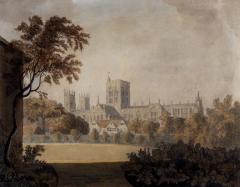
For several months, I have been researching for and working on another historical novel. The setting is in York, England, duirngthe last years of the Georgian era. Such a fascinating city with a wonderful history! The research has been challenging and enjoyable-at times, I find myself getting caught up in pursuing the reading and neglecting the writing. However, progress has been made!
The heroine is Anne Emmons, a young woman of respectable birth. There is wealth, accumulated in trade. The novel looks at friendship, the contrasts between the formal, stratified world of London society and the more flexible society of York, and the possibility of finding happiness on one’s own terms. Meanwhile, her father was concerned…. I thought I would introduce a few bits and pieces as I work. Here is the first bit:
He had hoped Anne would settle long before now. At twenty-five years of age, she had long participated in the social seasons at home in York, and in London. There was no doubt that Sir Henry and his wife had done their best by Anne, put her in the way of meeting eligible young men, even arranging for her presentation. Somehow, Anne had just never “taken.” Even at home in York, acting as his hostess, she had entertained numerous young men, ranging from young fashionables in town for the races to successful young merchants and bankers. She showed the poise of an older, more experienced hostess, yet never indicated the slightest tendre for any of them. “Not a one of ’em stirred so much as a flutter, ” he thought gloomily, “and for all the notice she paid, none had the least inclination to pursue it.” Well, he was going to have to take a hand, as distasteful as he found it.
I hope you will let me know what you think of this little segment!
Emily Lamb, Lady Cowper, was famous for her wit, charm and tact, and exercised great social power, not only as one of the Lady Patronesses of Almack’s, but in her later life as Lady Palmerston, wife of the Prime Minister. It is important to look at her family life to see how she evolved to her subsequent status.
Emily was born April 21, 1787 to Elizabeth, Lady Melbourne (born Milbanke) who was the wife of Peniston Lamb, Viscount Melbourne. Lady Melbourne was a woman who was part of the “Devonshire House set”, a famous hostess, and a highly powerful society figure. Lady Melbourne was noted for her ambition, her discretion, and her influence. Although the first child born of the marriage, a son, was undoubtedly that of her husband, Lady Melbourne had many affairs, including one with George, then the Prince of Wales, and the paternity of her other children (including Emily) was not clear. The Earl of Egremont was a possible candidate as Emily’s natural father. Although her affairs were not secrets, she conducted them with great tact, dignity and discretion; there is no indication of any scandal, and no record of any objection by Lord Melbourne. Elizabeth was also a loyal friend (if not a loyal wife). Emily was raised in a highly social and political circle and would have had the opportunity to learn her social skills from hostesses at the highest level of society, including her mother and Georgiana, Duchess of Devonshire. Her formal education was acquired from governesses. Emily was the fifth of six children, including her brother William (who married Caroline Lamb, and became a Prime Minister).
In 1805, at age 18, Emily was married to Peter Leopold Louis Francis Nassau Cowper, 5th Earl Cowper. Nine years older than Emily, Earl Cowper was the largest landowner in Hertfordshire, and invested as a Fellow in the Royal Society. He was also considered lacking in ambition, dull and slow of speech. Earl Cowper was also apparently uninterested in politics. He worked with Henry Repton on the building of a house on one of his estates during this period, and they had a son, George, in 1806. Emily threw herself into her social career, becoming a leading figure and one of the patronesses of Almack’s and, subsequently, a regular member of the court of George IV. She had a reputation for being the most popular of the lady patronesses, and was noted for her tact, apparently skilled at smoothing over the social conflicts and quarrels that sprang up in her social milieu. Four other children were born during the marriage, whose paternities are not clear. Like her mother, there was no scandal; apparently, her husband also raised no objection.
At Almack’s, Emily was seen more and more frequently in company with Henry John Temple, 3rd Viscount Palmerston (who was noted for his own romantic adventures). Lord Palmerston appeared regularly at Lady Cowper’s social functions. The nature of their relationship during this time was and is subject to a great deal of speculation; at the very least, they were good friends. (At most, they were intimate – Emily’s son William born in 1811 was considered very like Lord Palmerston, and ultimately bore the last name Cowper-Temple.) Her social career, however (as previously mentioned), was not blighted by open scandal, so we can assume that Emily learned not only deportment but discreet behavior from her mother.
Upon the death in 1818 of her mother, Lady Melbourne, Emily became increasingly involved in assisting her brothers with their affairs, communicating regularly with her brother Frederick (a diplomat) and attempting to guide her brother William through his marriage and career crises. William had fallen in love with and become engaged to Caroline Ponsonby (daughter of Henrietta who was the Duchess of Devonshire’s sister, and another member of the “Devonshire House Set”), and married her June 3, 1805. As a result, Caroline became the Caroline Lamb, subsequently famous for her affair with Byron, wild behavior, and uncontrolled emotions. The young couple lived with Lord and Lady Melbourne, which was a far from satisfactory arrangement for all. Emily had little use or sympathy for Caroline, all of her sympathies being with William. In 1816, Caroline published a novel GLENARVON anonymously. In this novel, Caroline portrayed herself as an abused heroine, and other members of society (including her husband and mother-in-law, and Byron) in extremely bad light. This tested William’s loyalty to the maximum, and almost resulted in a separation. After Lady Melbourne’s death, Emily tried to protect William from Caroline’s emotional upheaval. Caroline ultimately died January 26, 1828. Emily was convinced that William was relieved (although he never remarried).
Between her social duties, and family responsibilities, Emily was very busy during this period. When the Prince of Wales became King George IV in January of 1820, Emily was still active as lady patroness of Almack’s and a popular member of society. She became a prominent figure at court and, by the late 1820’s, she was also a prominent political hostess for the Whigs, the party espoused by her friend Lord Palmerston and her brother William. As William’s political career began to advance (he was Home Secretary in 1830, and Prime Minister in 1834), Emily acted as his hostess.
Earl Cowper, who seemed to be most notable for his absence in Emily’s life, died June 27, 1837. At this point, Queen Victoria had reigned 2 days. Per force, Emily spent a quiet year for the obligatory period of mourning. Lord Palmerston finally asked Emily to marry him. Apparently, the ages of the couple were a cause for concern (both being in their 50’s!), so the blessing of the queen was requested and given. They were married December 16, 1839. Emily became the leading political hostess in London society, and used her influence to support Lord Palmerston and his policies. Her social skills, charm and tact created a great deal of good will for him, and she was apparently very talented at gathering information. By all accounts, they lived happily together until his death in October 18, 1865. Emily passed away September 11, 1869, and was buried in Westminster Abbey, next to Lord Palmerston.
SOURCES:
Blythe, Henry. CARO The Fatal Passion. 1972: Coward, McCann Geoghegan, Inc. New York.
Murray, Venetia. AN ELEGANT MADNESS High Society in Regency England. 1998: Penguin, New York.
ThePeerage.com Person Page 2721. “Emily Mary Lamb.” Last edited Nov. 26, 2009. http://thepeerage.com/p2721.htm Viewed 2/29/2012.
ThePeerage.com Person Page 1379. “Peter Leopold Louis Francis Nassau Cowper, 5th Earl Cowper.” Last edited Feb. 20, 2011. http://thepeerage.com/p1379.htm
“Tart of the Week: Elizabeth Lady Melbourne.” Posted July 11, 2008. http:georgianaduchessofdevonshire.blogspot.com/2008/07/tart-of-the-week-elizabeth-lady-melbourne.html Viewed 2/20/2012