“Queen Sarah”

Best known as one of the feared Lady Patronesses of Almack’s, she was born Sarah Sophia Fane in March 3, 1785, the eldest daughter of John Fane, the 10th earl of Westmorland, and his wife Anne Child (or Sarah Anne Child), the only child of the banker, Robert Child. Disapproving of the marriage because Anne eloped at age 17 to Gretna Greene in 1782, with John Fane, her father Robert Child changed his will so that his estate would bypass her and go to either her second son or her eldest daughter.   Robert Child died the same year of his daughter’s marriage, so Sarah Sophia was born an heiress.  There is no indication of what Sarah Sophia’s relationship with her parents or siblings was.  Her mother died when Sarah Sophia was eight. 

Sarah Sophia married George Villiers, Viscount Villiers, on May 23, 1804, at home in Berkley Square.  However, there were several hints of an elopement to Gretna Green for her.  Many of the sources I found were careful not to cite the place of marriage.  (This may be a result of confusion with her mother, both being named Sarah.  It is also possible that Sarah Sophia and George did elope but also had a ceremony to satisfy family or convention.)  By all accounts, she held him in great affection.  George became the 5th Earl of Jersey and 8th Viscount Grandison in 1805. Sarah Sophia had inherited the Child fortune and property, including Osterley Park, at birth, and took control when she came of age in 1806. In an age of women as chattels, Sarah was unique in that her inheritance made her the senior partner of Child & Co., a position she held for over 60 years.    She took an active interest in the bank, visiting the premises, checking profit and loss statements, and intervening in employee issues.  The couple had five sons and three daughters, seven of whom survived to adulthood.

Sarah Sophia, also known as Sally, became a leader of the “Ton”, and wielded a great deal of influence in Society. Sarah Sophia was considered a great beauty.  She made a name for herself by being extremely rude and behaving theatrically. She chattered incessantly, acquiring the nickname of “Silence.” Determined to stand apart from her mother-in-law, the scandalous Frances, Lady Jersey, who was mistress of the Prince of Wales, Sarah Sophia made a great show of personal virtue, although she apparently throve on gossip. In spite of her affectations, she appears to have been regarded with affection by many of her peers.   In a letter written in 1816 to her brother, General Alexander Beckendorf, Princess Lieven described Lady Jersey as one of her “most intimate friends.”  (Princess Lieven also said in a later letter to Prince Metternich that “…Lady Jersey has the most dangerous tongue I know.”  Written in 1823, it would appear that there had been a falling out.)  Although she called herself Sally, one of her nicknames in Society was “Queen Sarah.”  When Lady Caroline Lamb published her novel GLENARVON in 1816, Lady Jersey was supposedly the inspiration for the character of Lady Augusta.  As a result, “Queen Sarah” banned Caroline from Almack’s, effectively ending Caroline’s social career. 

Sarah Sophia and her husband entertained at their home in Berkley Square, and Middleton Park in Oxfordshire.  They seem to have spent little time at Osterley Park in Middlesex.  Sarah Sophia is supposed to have introduced the Quadrille to Almack’s in 1815. She was a noted political hostess for her husband, who legally added the name of Child in 1819 to become George Child-Villiers, Earl of Jersey. An avid hunter and racing aficionado, her husband held offices in the households of William IV and of Queen Victoria.  Sarah Sophia was interested in politics, and not shy about expressing her opinions.  She apparently switched from Whig to Tory views by the 1820’s.  She supported Queen Caroline against George IV when he tried to divorce Caroline, wearing a portrait of Caroline in public.   Sarah  Sophia also spoke openly against the Reform Bill of 1832. 

George died October 3, 1859, followed shortly by their eldest son.   Her grandson (her oldest son’s son)   inherited the title.  After her husband’s death, she continued to entertain and take an interest in what was going on around her, especially charitable concerns including the establishment of schools on the family estates to assist tenants and laborers.  She died of a ruptured blood vessel, according to her obituary, at Berkley Square on January 26, 1867, at age 81, outliving her husband and six of her seven children.  Both Lord and Lady Jersey were buried at Middleton Stoney, Oxfordshire.

Lady Jersey’s fame lived on after her, and she appears in Regency romance novels by many authors, including Georgette Heyer,  frequently as a character.  She will also be seen in my upcoming novel, due out later this year.

[This is an expansion of some information I posted on Goodreads on Oct. 20, 2011 in the Historical Info for Historical Fiction Readers group.]

Gronow, Captain Rees Howell.  Reminiscences of Captain Gronow. Originally published 1862: Smith, Elder & Co., London; republished by IndyPublish.com, McLean, VA.

Quennell, Peter, ed. The Private Letters of Princess Lieven to Prince Metternich 1820-1826.  1938: E. P. Dutton & Co. Inc. NY. (P. 283)

Robinson, Lionel G.  Letters of Dorothea, Princess Lieven, during her Residence in London, 1812-1834. 1902: Longmans, Green, and Co. London. (P. 29)

“Child & Co, Bankers of London.”  http://www.hypatia.demon.co.uk/ost2006/historical_bank.html  

Find A Grave. “Sarah Sophia Fane Child-Villiers.”  http://www.findagrave.com/cgi-bin/fg.cgi?page=gr&GRid=91951396

“Osterley Park– A Brief History.”   http://www.hypatia.demon.co.uk/ost2006/historical_brief.html  

One London One blog.  “The Death of Lady Jersey in 1867.” By Kristine Hughes and Victoria Hinshaw.  Posted March 3, 2012. http://onelondonone.blogspot.com/2012/03/death-of-lady-jersey-in-1867.html

The Peerage Online.  “Lady Sarah Sophia Fane.”  http://www.thepeerage.com/p2703.htm

RBS Heritage Online. “Sarah Sophia Child-Villiers.” http://heritagearchives.rbs.com/wiki/Sarah_Sophia_Child-Villiers

Regency History.  “Lady Jersey (1785-1867).” By Rachel Knowles, posted Nov. 4, 2011.  http://www.regencyhistory.net/2011/11/lady-jersey-1785-1867.html

A Web of English History.  “Sarah Sophia Child, Lady Jersey, 1785-1867.” Dr. Marjory Bloy.   http://www.historyhome.co.uk/people/jersey.htm       

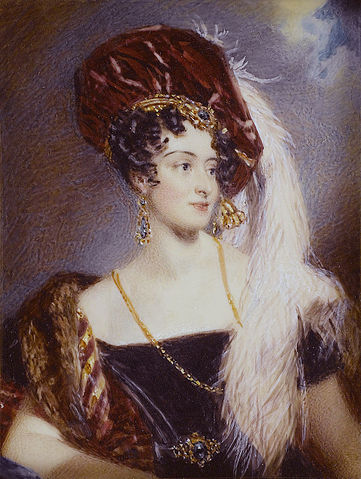
Image: from Wikimedia Commons- Sarah Sophia Child Villiers, Countess of Jersey (née Fane) (1785-1867) by Alfred Edward Chalon, painted in the first half of the 19th century. http://upload.wikimedia.org/wikipedia/commons/thumb/d/dc/Sarah_Sophia_Child_Villiers%2C_Countess_of_Jersey_%28n%C3%A9e_Fane%29_%281785-1867%29%2C_by_Alfred_Edward_Chalon.jpg/361px-Sarah_Sophia_Child_Villiers%2C_Countess_of_Jersey_%28n%C3%A9e_Fane%29_%281785-1867%29%2C_by_Alfred_Edward_Chalon.jpg


The “Infamous” Mrs. Drummond-Burrell

Born in Edinburgh, Scotland May 5, 1786, Sarah Clementina (or Clementina Sarah) was the daughter of James Drummond, Lord Perth, Baron Drummond of Stobhall and the Honorable Clementina Elphinstone.  The Drummond family was a noble family of Perthshire, who were loyal to the Jacobite cause.  After the Rising in 1715, the 4th Earl Drummond was attainted and the estates and title were lost (although still considered valid by the Jacobites in exile).  Clementina’s father obtained restoration of the estates in 1787, but the title was not restored; he was created 1st Lord Perth and Baron Stobhouse by George III in 1797 (he was considered the 11th earl de jure by the Jacobites in exile)*.    Clementina was the only surviving child and heir.   A number of compositions for dances were named for her, including “Clementina Sarah Drummond”, a strathspey by John Bowie published in 1789, and “Miss Sarah Drummond of Perth”, another strathspey.  On her father’s death in 1800, she inherited a large fortune and estates in Perthshire.

On October 19, 1807, at age 21, Clementina married the Honorable Peter Burrell, who was the son of Sir Peter Burrell, 2nd Baronet Burell of Knipp and subsequently Baron Gwyndir, and Lady Priscilla Bertie, 21st Baroness Willoughby de Eresby and the daughter of the 3rd Duke of Ancaster.  His family had no money to speak of.  On November 5, 1807, the couple took the name of Drummond-Burrell by royal license.   This was supposedly at her father’s insistence but, since he died in 1800, this may have been a requirement of her marriage settlement or her own request.  (I also saw an indication that this may have been at his father’s request.)  In any case, the couple became Mr. and Mrs. Drummond-Burrell.  Initially, at least, they lived at Drummond Castle.

Priscilla, Lady Willoughby de Eresby, by Sampson Towgood Roch (after a miniature painted by Saunders 1810) -Mother of Peter Robert Drummond-Burrell

Peter Drummond-Burrell was a great dandy, and a member of Brooks’s Club (a Whig stronghold), and had been working toward a political career.  He was elected Member of Parliament for Boston in Lincolnshire in April 1812, and usually voted with the opposition, although his attendance was not steady.  Clementina was an active hostess, noted for her parties.  By 1814, according to Captain Gronow, Clementina was one of the patronesses of Almack’s Assembly Rooms.  She had the reputation of being the highest stickler, very proud, and very grand.  In FRIDAY’S CHILD, Georgette Heyer described her as “the most coldly correct of Almack’s patronesses….”

There are some implications that this was not a particularly happy marriage.  Peter Drummond-Burrell was expensive, and his father was in debt; Clementina’s reputation for grandeur and shrewdness would not indicate a “soft touch” for cash.  However, after 1808, they appear to be fixed in London and very busy with their social and personal lives.  The couple had five children:  Clementina Elizabeth, born Sept. 2, 1809 in Piccadilly, Westminster; Elizabeth Susan, born Sept. 21, 1810 in Westminster, Charlotte Augusta born Nov. 3, 1815 in Berkley Square; Frederick, born Feb. 4, 1818 in Middlesex; and Alberic born Dec. 25, 1821.  Two of the children died before their parents.  Frederick died May 17, 1819, and Elizabeth died Oct. 10, 1853.  It is worth noting (considering the time) that I did not run across any speculation about the paternity of their children.   I also did not run across suggestions that Peter had a string of mistresses.  (A dandy’s lifestyle, combined with political aspirations, does justify a high level of expenditure!)  This would indicate a couple who, if not madly in love, at least cared about and respected each other.

Peter’s father died June 29, 1820, apparently significantly in debt, at which point Peter succeeded to his titles, becoming Lord Gwydyr.  His biography on THE HISTORY OF PARLIAMENT indicates he sold many family treasures and, rather than face another election, retired from politics to live in Paris by choice for a period of time.  How long he was in Paris, and whether Clementina went with him,  is unclear.  In any event, they were still a couple and in England fairly soon after this, as their fourth child Alberic was born December 25, 1821, and was christened at St. George’s, Hanover Square, December 30, 1821.   In 1828, his mother died, and he inherited her title, adding the 22nd Baron Willoughby de Eresby and Joint Hereditary Lord Great Chamberlain to his list of titles, invested in the Privy Council.  The couple was known as Lord and Lady Willoughby de Eresby from this point on.   Although the duties of Hereditary Lord Great Chamberlain and Privy Counselor required Lord Willoughby de Eresby’s presence at court, they continued to spend time at Drummond Castle where they were involved in continuing improvements, especially in the gardens.  In 1842, Queen Victoria supposedly planted copper beech trees at Drummond Castle during a visit.

Clementina died January 16, 1865 in Piccadilly, and was buried in St. Michael Churchyard, East Halton, Lincolnshire.  Peter died February 22, 1865, outliving her by only a month.

Clementina Drummond-Burrell was an influential society hostess, with the power to make or break a social career.  She had the reputation of being a high stickler, requiring a high standard of conduct in her protégés.  Certainly, I found no suggestion of scandal connected to her.   Her background as the only child of an earl, heiress to wealth and privilege, may have been a source of pride to her, and must surely have excited envy.  These things, however, do not necessarily require a cold, harsh personality.  Although in novels, she is portrayed as a rigid, implacable despot, the facts I found indicate an admirable person.  In REMINISCENCES OF CAPTAIN GRONOW, “Society in London in 1814,” he describes Lady Castlereagh and Mrs. Burrell “de tres grandes dames”1  (very great ladies).  I can think of worse things for which to be remembered.

Notes:

  1. Gronow, Captain Rees Howell.  REMINISCENCES OF CAPTAIN GRONOW. P. 19

*Corrected 3/31/2020.


Sources:

Gronow, Captain Rees Howell.  REMINISCENCES OF CAPTAIN GRONOW. 1862: Smith, Elder & Co. Cornhill.  Published in the U.S . by IndyPublish.com, McLean, VA.

Candice Hern Romance Novelist website. “ Leaders of Society and the Demimonde.”  http://www.candicehern.com/regency.htm

A Web of English History website.  “Mr. and Mrs. Drummond-Burrell (1782-1865; 1786-1865). Posted by Dr. Marjorie Bloy.  http://www.historyhome.co.uk/people/burrell.htm

The Peerage Online:  “Lady Sarah Clementina Drummond ”  and “James Drummond, 11th Earl of Perth.”  http://thepeerage.com/p2621.htm  , “Peter Robert Drummond-Burrell, 21st Baron Willoughby de Eresby.”  http://thepeerage.com/p2026.htm#i20260

Find A Grave website: “Lady Sarah Drummond Drummond-Burrell.”  http://www.findagrave.com/cgi-bin/fg.cgi?page=gr&GRid=73477058

The History of Parliament Online.  “DRUMMOND BURRELL, Hon. Peter Robert (1782-1865), of Drummond Castle, Perth.”   http://www.findagrave.com/cgi-bin/fg.cgi?page=gr&GRid=73477058

Traditional Tune Archive website.  “MISS SARAH DRUMMOND OF PERTH[1].”  http://tunearch.org/wiki/Annotation:Miss_Sarah_Drummond_of_Perth_(1

Community Trees Project.  “Individual Report for Clementina Sarah Drummond”   and “Individual Report for Alberic Drummond-Willoughby, Lord Willoughby of Eresby.”  http://histfam.familysearch.org

Regency Reader blog.  “Regency Villains: Mrs. Drummond Burrell.” Posted by Anne Glover, 2/24/2012.  http://anneglover.wordpress.com/2012/02/24/regency-villians-mrs-drummond-burrell/

Image from Wikimedia Commons: http://upload.wikimedia.org/wikipedia/commons/4/4e/Priscilla%2C_Lady_Willoughby_de_Eresby.png