I am privileged to host author Nancy Blanton, author of Sharavogue and her newest work The Prince of Glencurragh. Today, she is going to tell us about the source of inspiration for her new work. Over to Nancy…
I first started reading historical fiction as a teenager. I only dreamed I would one day be writing it, not believing the dream could come true. But I’ve since learned that inspiration can come from anywhere, and often the drive with it.
While researching 17th century Ireland for my second historical novel, The Prince of Glencurragh, I was stopped in my tracks by an arresting portrait of James Butler, the 12th Earl of Ormonde and the 1st Duke of Ormonde. I knew right away I had to find out more about him, because he was going to be featured in the book.
When I learned he had ascended to earldom in 1634 at just 24 years of age, I realized he was a contemporary of the characters I was already constructing. This earl became quite powerful, and led the passionate Royalist stand against English dominance under the boot of Oliver Cromwell and his army. He seemed to embody the ideal of beauty, money, and power.
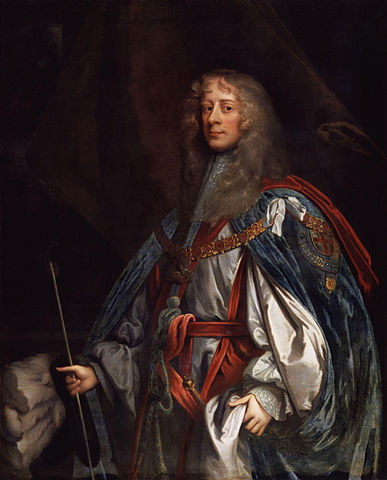
1st Duke of Ormonde by Sir Peter Lely (circa 1665) Public domain, Wikimedia Commons
This portrait captures Ormonde looking magnificent in ceremonial robes. He wears white satin trimmed in red and blue. Delicate hands grasp lance and sword; his jaw is proud, his eyes soulful and knowing. The long golden locks affirm his noble stature and remind me of a young, proud-faced Roger Daltrey, out to change the world in his own particular way – perhaps with similar sexual energy but without Daltrey’s penchant for fisticuffs.
No less appealing would have been James’s enormous wealth and power. He was born into a family tracing back to the Norman Invasion in the 12th century. The family seat became the great Kilkenny Castle from which they controlled the vast kingdom of Ormonde (including counties Waterford, Tipperary and Limerick).
Educated in London, James learned the Irish language, which was to serve him well later in life; and also met his cousin Elizabeth Butler, daughter of Sir Richard Preston, Earl of Desmond. Their marriage in 1629 ended the long-standing feud between the two families Butler and FitzGerald. In 1661, King Charles II created him the first Duke of Ormonde.
Biographer C.V. Wedgwood describes James Butler as a “high-hearted” nobleman: “Handsome, intelligent and valiant, he was also to the very core of his being a man of honor: loyal, chivalrous and just.”
And let’s not leave out dauntless. When the Lord Deputy of Ireland, Thomas Wentworth, ordered that the wearing of swords in Parliament would not be permitted, Ormonde told the official who tried to take his sword that the only way he’d get it was if it was “in his guts.” He ultimately won the argument.
In my novel, Ormonde brings his significant power and influence, his chivalrous mindset, and his own agenda to the story, along with a fierce belief in fairness, justice, and love.
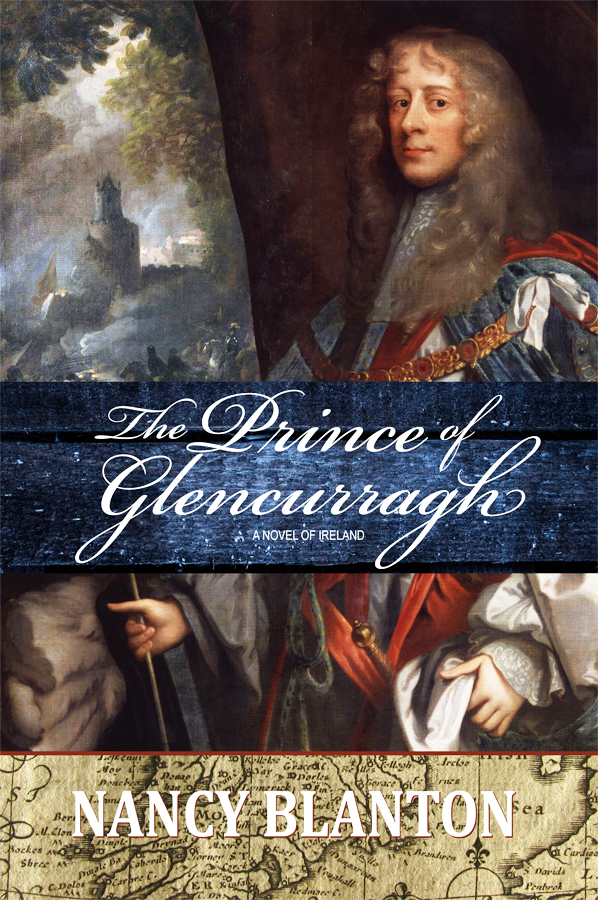
The Prince of Glencurragh, published in July 2016, is the three-time award-winning story of an Irish warrior who abducts a young heiress to help restore his stolen heritage and build the Castle Glencurragh. He is caught in the crossfire between the most powerful nobles in Ireland, each with his own agenda. The book is the stand-alone prequel to my first historical novel, Sharavogue, which begins with the arrival of Cromwell in Ireland, and follows the protagonist’s experiences on an Irish sugar plantation of Montserrat. Both books are available on amazon.com, barnesandnoble.com, and other online retailers. Find more information and links on my website, nancyblanton.com.
You can find the novel for purchase HERE.
Visit these fine blogs for more:
Jennifer B. Duffey HERE.
Andrea Patten HERE.
Janette Fudge Messmer HERE.
Nancy Blanton HERE.